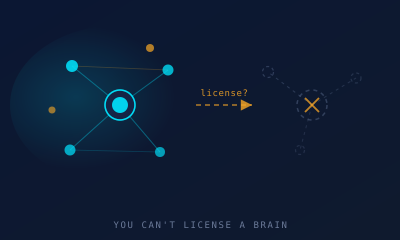
I've spent the last couple of years building a second brain, a personal vault of notes, transcripts and half-formed ideas that an AI can read and reason over. Once you've built one, a bigger idea shows up almost on its own. What if you didn't just build your second brain? What if you rented it?
The version that gets people excited goes like this. You generate a lot of valuable insight at work, and right now your employer gets all of it for free. Imagine instead that your brain is a service other people pay to query. A personal server that licenses your judgment by the use. YouTube for your mind: you keep the IP, the platform takes a cut. A digital twin that keeps earning after you've retired, or died.
I wanted this to be right. I've gone back and forth on it for weeks, and where I've landed, at least for now, is that it doesn't work, and the reasons turned out to be more interesting than the idea. I might be wrong. If you think I am, I'd like to hear it.
Start with what's right about it, because it's most of it. As AI floods the world with cheap, passable content, the real thing gets more valuable. You should own your context and be able to swap the model underneath it like a battery. The person who owns their data has leverage the person renting a chatbot doesn't. All true. The direction, toward ownership, is right. The mechanism is where I keep getting stuck.
Two tests
For something to be a rentable asset it has to pass two tests, and a brain fails both.
The first test: can you sell it without giving it away? This is where "YouTube for your mind" falls apart. A YouTube video is a finished thing. It's protected by copyright, it costs nothing to serve again, and the law spent a century deciding who owns it. An insight is none of that. Either it's the deep judgment you can't fully put into words, in which case it never makes it into the server. Or it's something you can spell out, in which case it leaks the second someone queries it and you can't charge for it twice. There's no copyright on an idea. The law protects the way you express a thing, never the knowing itself.
The second test is quieter and worse: can it be held responsible? Think about what a company buys when it hires a consultant. It isn't the slide deck. It's someone to blame when the deck is wrong, someone standing behind the call with something to lose. A digital twin has no skin in the game. You can't hand accountability to a copy of yourself. And this is the part that changed my mind: the same people most excited about renting their brain will tell you, in the next breath, that once AI does the grunt work the human's real value is the trust and the relationship. That is the exact part a twin can't hold. The idea argues against itself.
The bigger thing I keep coming back to
Zoom out and something larger is going on. There's an old idea in economics: companies exist because coordinating people through a market (finding them, negotiating, managing them) is expensive, so we bundle all of that into a firm. AI is about to make coordination a lot cheaper. So at the edges, the firm shrinks toward one person running a swarm of agents that used to take a team.
Not everything collapses to one person, though. Enormous capital, regulatory approval, decades of proprietary data, legal liability when things break: none of that fits inside an individual. It consolidates harder, because it's the only moat left. So the firm doesn't disappear. It splits. Commodity work scatters out to individuals, and the capital-and-liability-heavy work concentrates.
I spent years in energy, and it took me a while to notice I was arguing from the strongest case for my own side. In energy the moats are obvious: the capital, the regulation, the ground nobody else has rights to. Of course "your IP gets walled off inside the company" felt self-evident to me. I was standing in the one industry where it's most true. In ordinary knowledge work it's already eroding.
There's a tell, too. At big, knowledge-heavy companies, the most experienced people are often the least eager to pour their expertise into an internal AI, because that expertise is what makes them valuable and they can see where it goes once it's captured. Rational, in the moment. But it's a stall, not an ending. Eventually the company either makes it worth their while or hires people who rebuild the knowledge from scratch. It resolves, slowly and unevenly.
And even if you solved all of that, "rent your brain" lands somewhere uncomfortable: it's a lottery. YouTube is the honest version of the analogy. A tiny top slice earns almost everything and the long tail earns close to nothing. A world where you license your mind concentrates power in the handful of minds worth renting, while everyone else's twin is worth about zero.
So what can you own?
Here's where I've ended up, and it's the part I believe. The instinct to own something is right. It's aimed at the wrong target. Three things pass both tests:
                      can you fence it?   a throat to choke?
  an insight          no                  no        ->  not yours to sell
  your judgment       yes, it's you       yes       ->  ownable
  proprietary data    yes, not online     yes       ->  ownable
  your reputation     yes                 yes       ->  ownable, and uncopyable
Judgment. The point of a second brain isn't an inventory you sell. It's that working through all that material makes your calls better.
Proprietary data. The scarce input was never the insight. It's the raw material that isn't anywhere online: your own receipts, logs, first-party observations, the relationships only you have. Insights leak, and data you own doesn't.
Reputation. This is the quiet winner, because it's the only asset that is ownable, portable and impossible to copy at the same time. Someone can take your notes. They can't take the fact that you were right, in public, on the record, for years.
So the strategy flips. Don't try to sell your brain. Use it to become the person whose judgment people trust and whose track record can't be faked, and leave the receipts where people can see them. That's the least futuristic advice imaginable. But if the next decade rewards what can't be copied, that's the side I'd rather be building on.
Written as I think it through, not from a settled view. I've argued myself in and out of half of this more than once. If you're building a second brain too, or you think I've got this wrong, I'd like to compare notes.